Regal Pelargonium Root Rot: Signs, Causes and Treatment
Root rot in a Regal Pelargonium is a deterioration of root tissue, often associated with a persistently unhealthy root environment. A plant may show yellowing, wilting, stalled growth or general decline above the soil, but these symptoms alone do not confirm root rot. The diagnosis becomes much stronger when declining top growth is combined with persistently wet growing medium and visibly deteriorating roots.
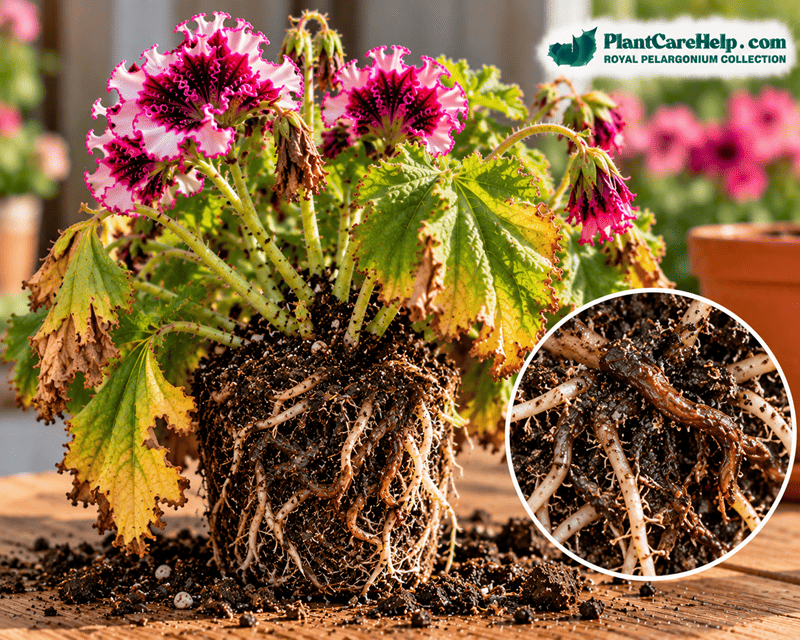
What is root rot?
Root rot describes deterioration of root tissue. Healthy roots are essential because they support water and nutrient uptake and anchor the plant in its growing medium.
When roots deteriorate, the top of the plant may begin to show symptoms even though the original problem is below the surface.
Root problems can become more likely when the root zone remains unsuitable for an extended period, particularly when excessive moisture and poor drainage are involved.
Possible signs of root rot in Regal Pelargoniums
💧 Persistently wet soil
Growing medium that remains excessively wet provides an important clue when it occurs together with plant decline.
🍃 Yellowing foliage
Yellow leaves can accompany root stress, although yellowing alone does not diagnose root rot.
🥀 Wilting despite wet soil
A plant may wilt even when moisture is present if unhealthy roots are no longer functioning normally.
🌱 Stalled growth
Weak, slow or stopped growth can occur when the root system is under significant stress.
🪴 Deteriorating roots
Visible root deterioration provides much stronger evidence than symptoms seen only on the leaves.
📉 Continuing decline
A combination of worsening symptoms deserves closer investigation of the root zone.
1. Do not diagnose root rot from leaves alone
Yellowing, wilting and poor growth can all occur for reasons unrelated to root rot. For example, severe drying, environmental stress and other growing problems can create similar symptoms above the soil.
That is why root rot should not be diagnosed simply because a plant looks unhealthy. Start by checking the moisture condition of the growing medium and the plant's recent care history.
2. Check whether the growing medium stays wet
Persistent wetness is an important warning sign. Ask whether the pot has been remaining wet much longer than expected between waterings.
Check:
- whether the plant has been watered again while the medium was still wet;
- whether excess water can leave the container;
- whether the pot remains in collected water;
- whether the growing medium has become dense or compacted;
- whether environmental conditions have changed and slowed drying.
Wet soil alone does not prove root rot, but wet soil combined with continuing plant decline deserves attention.
3. Wilting despite wet soil is an important clue
Wilting is often mistaken for underwatering. However, if the plant is drooping while the root zone remains persistently wet, adding more water is not an appropriate automatic response.
Instead, investigate drainage and root health.
Wet soil + persistent wilting + continuing decline is a reason to examine the root environment rather than simply watering again.

4. Yellow leaves can accompany root problems
Root stress can affect the appearance of foliage, including yellowing. But many other conditions can also cause yellow leaves.
Yellowing becomes more relevant to a root-rot diagnosis when it appears alongside persistent wetness, wilting, poor growth or visible root deterioration.
5. Root rot can be associated with stalled growth
A damaged root system may be unable to support normal active growth. The plant may produce little new foliage or appear to stop growing.
Do not respond by automatically increasing fertilizer. If roots are unhealthy, the root problem needs attention first.
6. What do healthy Regal Pelargonium roots look like?
Healthy roots should appear structurally intact and firm rather than collapsing or disintegrating when handled gently. Their exact color can vary with age, growing medium and staining from the potting mix, so color alone should not be used as the only diagnostic feature.
Look at texture and structural integrity as well as appearance.
7. What can unhealthy roots look like?
Roots affected by substantial deterioration may appear darkened, soft, weak, damaged or structurally degraded. Some may separate or break down easily when handled.
Do not diagnose root rot merely because individual roots are darker than expected. Growing medium can stain roots, and naturally older roots may not look identical to fresh new roots.
The most useful diagnosis combines root condition with moisture history and the symptoms of the whole plant.

8. What causes root rot?
Root deterioration can have more than one contributing factor. In container-grown Regal Pelargoniums, a persistently unsuitable root environment is an important problem to investigate.
Factors that can contribute include:
- prolonged excessive moisture;
- poor drainage;
- watering too frequently for current conditions;
- a pot that remains in collected water;
- dense or compacted growing medium;
- an unsuitable container or root environment;
- root injury followed by unfavorable conditions;
- plant pathogens affecting compromised root tissue.
The practical goal is to identify and correct the conditions that allowed the roots to deteriorate.
9. Overwatering and root rot are not identical
A plant can experience excessive moisture without already having substantial root deterioration. Overwatering describes an excessively wet root environment, while root rot describes actual damage and breakdown of root tissue.
This distinction matters because an overwatered but otherwise stable plant may recover after its moisture conditions are corrected, whereas a plant with seriously deteriorated roots may require more direct intervention.
10. Poor drainage can keep the root zone unhealthy
Drainage problems can allow excessive moisture to remain around the roots. Check that the container has functional drainage holes and that excess water can leave freely.
Also make sure the pot is not repeatedly left standing in water after irrigation.
11. Growing medium can contribute to root problems
A dense, compacted or otherwise unsuitable growing medium can make moisture management difficult. If the medium remains saturated for prolonged periods, correcting only the watering schedule may not fully solve the root environment.
When repotting is justified, use a suitable growing medium that supports healthy drainage and root development.
12. Pot size matters too
An unnecessarily large pot can hold a greater volume of wet growing medium around a relatively small root system. This may change how slowly the root zone dries.
Choose a container appropriate for the actual root system rather than moving a struggling plant into a dramatically larger pot.
13. How to inspect the roots
Root inspection is most useful when there is a genuine reason to suspect a root problem. Do not repeatedly remove a healthy, stable plant from its pot simply to check it.
When inspection is justified:
- Handle the plant and root ball carefully.
- Observe whether the growing medium is saturated, moderately moist or dry.
- Look at the condition and structure of the roots.
- Identify clearly deteriorated tissue rather than judging from color alone.
- Assess how much healthy root tissue remains.
- Use these observations to decide whether repotting and removal of damaged roots are necessary.
14. How to treat Regal Pelargonium root rot
Treatment depends on how much root deterioration is actually present. The goal is to remove clearly unhealthy tissue when necessary and restore a suitable root environment.
- Stop adding water while the root zone is already excessively wet.
- Remove the plant from the container when root inspection is justified.
- Gently remove enough old growing medium to evaluate the affected roots.
- Identify roots that are clearly deteriorated, soft or structurally damaged.
- Remove clearly dead or badly deteriorated root tissue with clean tools.
- Use a clean container with functional drainage.
- Repot in suitable fresh growing medium when repotting is necessary.
- Return the plant to suitable environmental conditions.
- Adjust future watering to the actual moisture condition of the root zone.
- Monitor the plant for stabilization and healthy new growth.
Do not remove healthy roots unnecessarily. The objective is to preserve viable root tissue while correcting the conditions that contributed to deterioration.

15. Use clean tools
If damaged roots need to be removed, use clean cutting tools. Avoid crushing or unnecessarily damaging healthy root tissue while working.
Clean tools are also good practice when moving between plants, particularly when disease may be involved.
16. Should you reuse the old growing medium?
When a plant is being repotted because of significant root deterioration, fresh suitable growing medium is generally preferable to placing compromised roots back into the same problematic root environment.
Also correct any drainage or container issue that contributed to the original problem.
17. Should you use a bigger pot after root rot?
Not automatically. If damaged roots have been removed, the remaining root system may actually be smaller than before.
Choose a container that is appropriate for the remaining healthy roots. A much larger volume of growing medium can complicate moisture management.
18. Should you fertilize immediately?
Fertilizer does not repair rotted roots. A recently treated plant should first have a suitable root environment in which the remaining healthy roots can function.
Return to an appropriate feeding routine according to the plant's condition and active growth rather than applying extra fertilizer as an emergency treatment.
19. Should you water immediately after repotting?
Watering decisions should depend on the condition of the new growing medium, the remaining roots and the reason the plant was repotted. Avoid automatically saturating an already stressed root system simply because repotting has occurred.
Afterward, use root-zone moisture rather than a rigid calendar to guide future watering.
20. Should you prune the top of the plant?
Do not automatically perform heavy top pruning simply because root rot is present. The amount of foliage removed should depend on the actual condition of the plant and whether tissue is dead, badly damaged or otherwise needs removal.
Avoid combining unnecessary major changes while the plant is already stressed.
21. Can a Regal Pelargonium recover from root rot?
Recovery depends on the severity of root damage and how much viable plant tissue remains. A plant with a substantial amount of healthy root and stem tissue has a different outlook from one with extensive deterioration.
There is no universal recovery time. Monitor the plant for stabilization and subsequent healthy growth.
22. Signs of recovery
Old damaged foliage may not return to its previous appearance. Instead, watch for:
- the end of continuing decline;
- stable stems and foliage;
- improved leaf firmness;
- the root zone no longer remaining persistently saturated;
- healthy shoot tips;
- new leaves beginning to develop.
Healthy new growth is more informative than expecting damaged old tissue to become normal again.
23. What if the plant continues to decline?
If deterioration continues after the root environment has been corrected, reassess the plant. Check whether unhealthy roots or stem tissue remain and whether another problem is contributing.
When very little healthy root tissue remains, saving healthy stem material for propagation may be worth considering if suitable material is available.
24. Root rot versus underwatering
Both root problems and severe drying can produce wilted foliage. The root-zone condition helps separate them.
Very dry root zone
Wilting with genuinely dry growing medium points toward severe drying as a likely factor.
Persistently wet root zone
Wilting with wet soil and continuing decline makes drainage and root health important to investigate.
25. How to prevent root rot
Prevention focuses on maintaining a healthy root environment.
- Check the growing medium before watering.
- Avoid repeatedly watering an already wet root zone.
- Use a container with functional drainage holes.
- Do not leave the pot standing in collected water.
- Use an appropriate growing medium.
- Choose a suitable container size.
- Adjust watering when temperature, light or season changes.
- Monitor plants after repotting or relocation.
- Respond to persistent wetness before substantial decline develops.
26. Seasonal changes can increase risk
A watering routine that worked during warm, active growth may become excessive when the plant's environment changes. Lower light, cooler conditions or reduced growth can alter how quickly the growing medium dries.
Continue checking moisture instead of assuming that the same watering interval is appropriate throughout the year.
27. Root problems after bringing a plant indoors
Moving a Regal Pelargonium indoors can change light, temperature and airflow. The pot may begin drying more slowly than it did outdoors.
Reassess watering after the move rather than automatically continuing the previous routine.
28. Do fungicides automatically solve root rot?
No single treatment should be applied automatically to every plant with declining roots. Root deterioration can involve different contributing factors, and correcting excessive moisture, poor drainage and unsuitable root conditions remains essential.
Avoid applying products simply because leaves are yellow or wilted without first establishing what is happening in the root zone.
29. When to take cuttings as a backup
If the root system is severely compromised but healthy, firm stem material remains, propagation can provide a backup option.
Use only suitable healthy material rather than obviously deteriorating tissue.

Regal Pelargonium root rot checklist
1. Check moisture
Is the growing medium remaining persistently wet?
2. Check drainage
Can excess water leave the container freely?
3. Check plant symptoms
Look for wilting, yellowing, stalled growth and continuing decline.
4. Inspect roots when justified
Look for structural deterioration rather than judging roots by color alone.
5. Remove clearly damaged roots
When treatment requires it, remove badly deteriorated tissue with clean tools while preserving healthy roots.
6. Correct the root environment
Address poor drainage, unsuitable growing medium or other conditions contributing to prolonged wetness.
7. Use an appropriate pot
Match container size to the remaining root system rather than automatically using a larger pot.
8. Adjust watering
Water according to root-zone moisture instead of following a rigid calendar.
9. Avoid automatic treatments
Do not use extra fertilizer or unrelated treatments as a substitute for correcting the root problem.
10. Monitor recovery
Watch for stabilization, healthy shoot tips and new foliage.
Frequently asked questions
What are the signs of root rot in Regal Pelargoniums?
Possible signs include persistently wet growing medium, yellowing, wilting despite wet soil, stalled growth and general decline. Visible deterioration of the roots provides stronger evidence than leaf symptoms alone.
What do rotting roots look like?
Substantially deteriorating roots may be darkened, soft, weak or structurally degraded and may break down easily. Do not diagnose root rot from color alone because growing medium and root age can affect appearance.
Can overwatering cause root rot?
Prolonged excessive moisture can create an unhealthy root environment and contribute to root deterioration. However, overwatering and root rot are not identical: one describes excessive moisture conditions, while the other describes actual root damage.
Can a plant with root rot wilt even when the soil is wet?
Yes. A plant with seriously compromised roots may wilt despite moisture being present in the growing medium. That is why wet soil plus persistent wilting deserves investigation.
Should I cut off rotten roots?
Clearly dead or badly deteriorated roots can be removed when treatment requires it. Use clean tools and avoid removing healthy root tissue unnecessarily.
Should I repot a Regal Pelargonium with root rot?
Repotting may be appropriate when root deterioration is confirmed and the existing growing medium or container no longer provides a suitable root environment. Use a clean, appropriately sized container with functional drainage.
Should I use a larger pot after removing damaged roots?
Not automatically. Choose the new container according to the remaining healthy root system rather than the original size of the plant.
Should I fertilize after treating root rot?
Do not use fertilizer as an emergency treatment for damaged roots. First establish a suitable root environment and allow the plant to stabilize.
Can a Regal Pelargonium recover from root rot?
Recovery is possible when sufficient healthy plant tissue remains, but the outcome depends on the severity of the damage. Healthy new growth and the end of continuing decline are useful signs of recovery.
How can I prevent root rot from returning?
Check root-zone moisture before watering, maintain functional drainage, avoid standing water, use appropriate growing medium and pot size, and adjust watering when environmental conditions change.
The most important rule
Do not diagnose Regal Pelargonium root rot from yellow or wilted leaves alone. Check the root zone. Persistent wetness, continuing decline and visibly deteriorating roots provide much stronger evidence. Treatment should preserve healthy tissue while correcting the moisture, drainage or root-environment problem that contributed to the damage.
Regal Pelargonium varieties
Explore the PlantCareHelp Regal Pelargonium catalog for photographs and individual variety pages.