Regal Pelargonium vs Geranium: What’s the Difference?
Regal Pelargoniums are often called geraniums, but botanically they belong to the genus Pelargonium, not the genus Geranium. Both genera belong to the geranium family, Geraniaceae, which helps explain the long-standing name confusion. In everyday gardening language, however, the word “geranium” is still frequently used for ornamental Pelargoniums.

Quick answer: Regal Pelargonium or geranium?
A Regal Pelargonium is a Pelargonium. It is not botanically a member of the genus Geranium.
The confusion comes from common naming. Many ornamental Pelargoniums have traditionally been sold and described as “geraniums,” and that common name remains widely used.
The easiest rule to remember: “geranium” can be a common gardening name, while Geranium and Pelargonium are separate botanical genera.
Regal Pelargonium vs Geranium at a glance
| Feature | Regal Pelargonium | True Geranium |
|---|---|---|
| Botanical genus | Pelargonium | Geranium |
| Plant family | Geraniaceae | Geraniaceae |
| Common naming | Frequently called a geranium in horticulture | Correctly belongs to the genus Geranium |
| Flower symmetry | Flowers are commonly bilaterally symmetrical | Flowers are commonly radially symmetrical |
| Regal group | Yes — Regal is a cultivated Pelargonium group | No |
| Typical garden identity | Showy ornamental Pelargonium with large flowers | Plants commonly known as cranesbills or hardy geraniums |
Why are Pelargoniums called geraniums?
The use of “geranium” for Pelargoniums is historical and remains deeply established in everyday horticultural language. As a result, a plant sold as a “geranium” may actually belong to the genus Pelargonium.
This is particularly common with familiar ornamental groups such as Regal and Zonal Pelargoniums.
For accurate botanical identification, the genus name is therefore more useful than the common name alone.
Are Pelargonium and Geranium related?
Yes. Pelargonium and Geranium are separate genera within the same botanical family, Geraniaceae.
Their relationship helps explain why the plants share some general family characteristics and why their names became historically connected. However, being members of the same family does not make them the same genus.

What is a Regal Pelargonium?
Regal Pelargoniums are cultivated ornamental Pelargoniums valued especially for their large, striking flowers. They are also commonly known in horticulture as regal geraniums or Martha Washington geraniums.
Their flowers can display strong contrasts, blotches, veining and combinations of colors. The exact appearance varies widely among cultivars.
The PlantCareHelp catalog focuses specifically on this diverse ornamental group.
What does “Regal” mean?
“Regal” identifies a horticultural group within Pelargonium. It does not mean that the plant belongs to a separate botanical genus.
So the name can be understood as:
Regal Pelargonium = a cultivated group of plants within the genus Pelargonium.
What is a true Geranium?
A true geranium belongs to the botanical genus Geranium. Many garden species and cultivars in this genus are commonly called cranesbills or hardy geraniums.
They should not be confused botanically with Regal, Zonal or other ornamental Pelargonium groups.
Is “true geranium” an official botanical name?
“True geranium” is an informal phrase used to make the distinction clearer when comparing the genus Geranium with plants commonly called geraniums that actually belong to Pelargonium.
The botanical genus itself is simply Geranium.
Flower differences
Flower structure is one useful way to understand the distinction between the two genera.
🌸 Regal Pelargonium flowers
Pelargonium flowers are commonly bilaterally symmetrical, meaning the flower can generally be divided into matching halves along one principal plane.
🌺 Geranium flowers
Geranium flowers are commonly radially symmetrical, with petals arranged more evenly around the flower center.
Cultivars can vary considerably, so flower symmetry should be considered together with the plant's overall identity rather than used as the only identification feature.

Regal Pelargonium flower appearance
Regal Pelargoniums are especially recognizable for their showy flower clusters. Depending on the cultivar, individual flowers may be broad and richly marked.
Common visual features among cultivars can include:
- large ornamental flowers;
- strongly contrasting petal colors;
- dark or prominent petal blotches;
- visible veins or markings;
- two-tone or multicolored flowers;
- dense displays when several flowers are open together.
Not every cultivar displays all of these characteristics, so individual variety identification should be based on the actual cultivar rather than a generic description.
True Geranium flower appearance
Plants in the genus Geranium generally show a more radially balanced flower structure. The petals are arranged around the flower center with a more regular symmetry than is typical of Pelargonium.
Flower color, plant size and foliage vary among Geranium species and cultivars, so no single color or leaf shape identifies the entire genus.
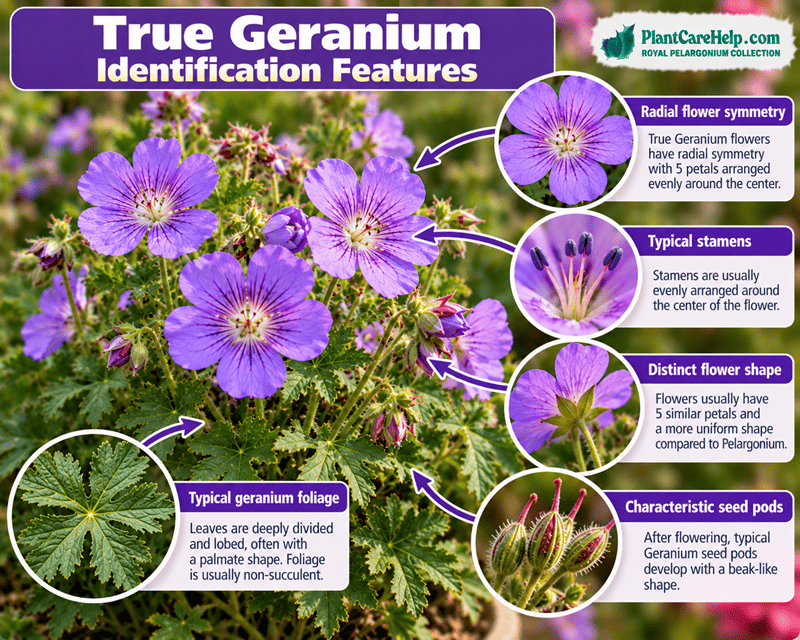
Can you identify them from the leaves?
Leaves can provide useful clues, but foliage varies substantially among species, hybrids and cultivars in both genera.
For that reason, avoid identifying a plant solely because its leaf looks like a familiar “geranium leaf.” Use several characteristics together, including:
- flower structure;
- growth habit;
- foliage;
- cultivar or nursery label;
- botanical name when available.
Are Regal Pelargoniums hardy geraniums?
No. The term “hardy geranium” generally refers to garden plants in the genus Geranium, not Regal Pelargoniums.
Calling a Regal Pelargonium a “geranium” in everyday conversation is common, but calling it a true or hardy Geranium would blur an important botanical distinction.
Is a Martha Washington geranium a Regal Pelargonium?
“Martha Washington geranium” is a common horticultural name used for Regal Pelargoniums. Despite the word “geranium” in the common name, these plants belong to Pelargonium.
This is a good example of why common names and botanical names can appear contradictory.
Is a Regal Pelargonium the same as a Zonal Pelargonium?
No. Both are Pelargoniums, but Regal and Zonal Pelargoniums represent different horticultural groups.
They can differ in flower appearance, foliage, growth characteristics and cultivation behavior. Therefore, identifying a plant simply as a Pelargonium does not tell you which horticultural group it belongs to.
Does the name affect plant care?
Yes, correct identification matters because plants that share the common name “geranium” are not necessarily managed in exactly the same way.
A care guide written specifically for Regal Pelargoniums should be followed for a Regal Pelargonium rather than assuming that every plant called a geranium has identical requirements.
Why correct identification matters
Correct identification helps you:
- find care information for the right plant;
- understand its growth pattern;
- compare cultivars accurately;
- avoid confusing different horticultural groups;
- search for appropriate propagation and seasonal-care information;
- use botanical and common names more accurately.
What should a plant label say?
A professionally labeled plant may include the genus, horticultural group and cultivar name. For a Regal Pelargonium, the word Pelargonium is the important botanical clue.
Retail labels vary, and some may use only a familiar common name such as “Regal Geranium.” That wording is horticulturally understandable but does not mean the plant belongs to the genus Geranium.
Regal Geranium vs Regal Pelargonium
In ordinary gardening language, these two expressions are often used for the same horticultural plants.
However, Regal Pelargonium is the clearer name when botanical accuracy matters because it immediately identifies the plant as a member of Pelargonium.
Do not assume that every plant sold as a “geranium” belongs to the genus Geranium. Check the botanical name whenever precise identification matters.
Pelargonium vs Geranium: botanical naming
Scientific names are useful because common plant names can differ between countries, nurseries, gardening traditions and languages.
When the genus is known:
- Pelargonium identifies a Pelargonium;
- Geranium identifies a true botanical Geranium.
Both remain members of Geraniaceae.
Can Regal Pelargoniums and Geraniums look similar?
They can share enough general family resemblance to contribute to confusion, especially for gardeners who know both simply by the common name “geranium.”
But once flower structure, botanical labeling and horticultural group are considered together, the distinction becomes much clearer.

How to identify which plant you have
- Check the plant label for the botanical genus.
- Look for Pelargonium or Geranium.
- Examine the overall flower structure.
- Consider whether the plant was sold as a Regal, Zonal or another Pelargonium group.
- Compare the foliage and growth habit.
- If a cultivar name is available, use it to confirm the plant's identity.
If the label says “Regal Geranium”
A plant labeled “Regal Geranium” is generally referring to the horticultural group commonly known as Regal Pelargoniums.
The common use of “geranium” does not change the botanical genus.
If the label says “Pelargonium”
You know the plant belongs to Pelargonium, but you may still need additional information to determine whether it is Regal, Zonal or another horticultural type.
Use the group name, cultivar name and visible characteristics together.
If the label says “Geranium”
The meaning depends on whether the label is using a botanical name or a common horticultural name.
If Geranium is clearly presented as the botanical genus, the plant is a true Geranium. If “geranium” appears only as a common retail name, additional identification may be needed.
Regal Pelargonium care basics
Once you have confirmed that the plant is a Regal Pelargonium, use care information written for that group. Important areas include:
- appropriate light;
- careful watering;
- good drainage;
- suitable growing medium;
- appropriate feeding;
- pruning and deadheading;
- seasonal temperature management;
- overwintering where required.
Frequently asked questions
Is a Regal Pelargonium a geranium?
It is commonly called a geranium, but botanically it belongs to the genus Pelargonium, not the genus Geranium.
Are Pelargonium and Geranium the same genus?
No. They are separate genera, although both belong to the Geraniaceae family.
Why do garden centers call Pelargoniums geraniums?
“Geranium” has a long history as a common horticultural name for Pelargoniums and remains widely recognized by gardeners.
What is a true geranium?
A true botanical geranium is a plant belonging to the genus Geranium. Many are also known as cranesbills or hardy geraniums.
What is a Regal geranium?
“Regal geranium” is a common name for a Regal Pelargonium. The plant belongs botanically to Pelargonium.
Is a Martha Washington geranium a Pelargonium?
Yes. Martha Washington geranium is a common horticultural name associated with Regal Pelargoniums.
Are Regal and Zonal Pelargoniums the same?
No. They are different horticultural groups within Pelargonium.
Can I identify Pelargonium and Geranium by flower symmetry?
Flower symmetry is a useful clue. Pelargonium flowers are commonly bilaterally symmetrical, while Geranium flowers are commonly radially symmetrical. Use this feature together with botanical labeling and other plant characteristics.
Are hardy geraniums Regal Pelargoniums?
No. “Hardy geranium” generally refers to plants in the genus Geranium, whereas Regal Pelargoniums belong to Pelargonium.
Which name should I use: Regal Geranium or Regal Pelargonium?
Both may be understood in horticultural conversation, but Regal Pelargonium is more botanically precise.
The easiest way to remember the difference
Regal Pelargonium = Pelargonium.
True geranium = Geranium.
They are related members of the Geraniaceae family, but they are not the same botanical genus. The everyday word “geranium” is the main reason the two are so often confused.
Regal Pelargonium varieties
Explore the PlantCareHelp Regal Pelargonium catalog to compare individual cultivars, flower colors and photographs.