Why Is My Regal Pelargonium Not Flowering?
A Regal Pelargonium may produce healthy leaves but few or no flowers when one or more growing conditions are not supporting normal bud development. Light, temperature, plant maturity, pruning, feeding, watering, root conditions and seasonal timing can all influence flowering.

Why does my Regal Pelargonium have leaves but no flowers?
Healthy foliage without flowers usually means that vegetative growth is occurring, but the plant has not developed or maintained flower buds successfully.
There is rarely one universal explanation. A plant may simply be at the wrong stage of its seasonal cycle, or several environmental and care factors may be interacting.
Before changing fertilizer, watering or pruning, examine the plant's current growing conditions and recent care history.
Common reasons Regal Pelargoniums do not flower
☀️ Insufficient useful light
Weak light can contribute to soft, stretched vegetative growth and poor flowering.
🌡️ Unsuitable temperature conditions
Temperature influences growth and flower development, and persistent stressful conditions can interfere with normal flowering.
🌱 Excessive or poorly timed feeding
Trying to force flowers with additional fertilizer can produce unbalanced growth rather than solve the underlying problem.
✂️ Pruning at the wrong stage
Removing developing flowering growth can delay or reduce the display you expected.
💧 Watering problems
Both severe drying and persistently saturated root conditions can stress the plant.
🪴 Root-zone problems
Poor drainage, damaged roots or an unsuitable growing medium can affect overall plant performance.
🌿 Plant still establishing
A recently rooted, repotted or stressed plant may prioritize root and shoot development before flowering strongly.
📅 Seasonal timing
Regal Pelargoniums do not necessarily maintain the same flowering intensity throughout the year.
1. The plant may not be getting enough light
Light is one of the first conditions to evaluate when a Regal Pelargonium is growing but failing to flower.
A plant kept in weak light may continue producing leaves and stems, but growth can become elongated and less compact.
Look at the entire growth pattern. Longer spaces between leaves, stems reaching toward the brightest direction and weak, stretched growth can indicate inadequate useful light.
Move the plant toward better light gradually if its previous conditions were substantially dimmer. Avoid making an abrupt transition from protected conditions to harsh exposure.

2. Temperature can influence flowering
Regal Pelargoniums respond to seasonal and environmental temperature changes. Temperature affects the rate of growth, water use and flower development.
Persistent excessive heat can stress the plant, while damaging cold can injure growth. Indoor plants may also experience unusually warm conditions near radiators, fireplaces or hot-air vents.
Instead of trying to create one exact temperature at all times, aim for stable conditions that avoid damaging extremes and support healthy plant development.
3. Too much fertilizer will not guarantee flowers
When a plant refuses to flower, adding more fertilizer can seem like an obvious solution. It is not always the correct one.
Fertilizer supports plant nutrition, but it cannot compensate for inadequate light, root problems, unsuitable temperature or incorrect watering.
Excessive or unnecessary feeding can also encourage unbalanced growth. Evaluate the whole growing environment before changing the feeding routine.
Use fertilizer according to the product directions and the plant's actual stage of growth. Do not repeatedly increase the amount in an attempt to force buds.
More fertilizer does not automatically mean more flowers. If a Regal Pelargonium is not blooming, first investigate light, temperature, watering, roots, pruning and seasonal growth.

4. Recent pruning may delay flowering
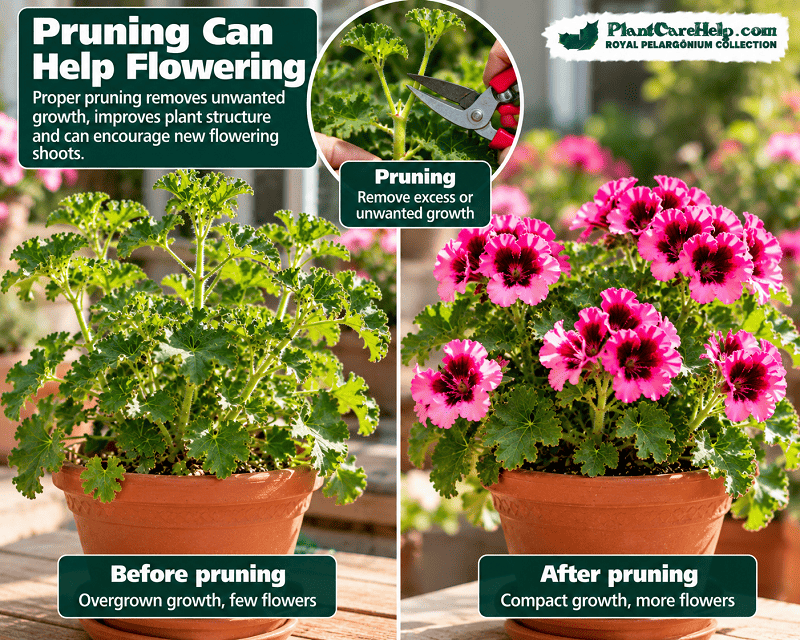
Pruning changes which shoots remain on the plant. If stems that were approaching flowering are removed, the plant needs time to develop replacement growth.
This does not mean pruning is harmful. Correct pruning can be useful for plant structure, removing damaged growth and managing an overgrown plant.
The important point is timing. Repeatedly cutting back healthy growing shoots while expecting immediate flowering can work against that goal.
5. Pinching also changes flowering timing
Pinching removes the growing tip of a shoot and can encourage development of side shoots. However, the plant then needs time to develop those shoots.
If a Regal Pelargonium is repeatedly pinched, flowering can be delayed because new growth continues to be redirected.
Use pinching selectively when plant structure needs it rather than continuously removing every new growing tip.
6. Overwatering can interfere with healthy growth
Regal Pelargonium roots need both moisture and air. If the growing medium remains continuously saturated, root conditions can deteriorate.
A plant with stressed roots may show yellowing, wilting or weak growth and may not perform normally even if the upper part of the plant initially appears green.
Check the growing medium before watering and make sure excess water can leave the container. Do not leave the pot standing in collected water.
7. Severe drying can also stress the plant
Allowing a Regal Pelargonium to become severely dry repeatedly can stress leaves, shoots and developing buds.
The answer is not to keep the soil permanently wet. Instead, monitor the growing medium and adjust watering to the plant's actual water use.
Container size, light, temperature, airflow and active growth all influence how quickly the medium dries.
8. Poor drainage may be affecting the roots
Even a careful watering routine cannot work well if excess water has nowhere to go.
Check that the container has functioning drainage holes and that the growing medium has not become excessively dense or compacted.
If root conditions are poor, address the underlying drainage problem rather than trying to stimulate flowering with fertilizer.
9. The pot may not be the real problem
When a plant does not flower, growers sometimes assume that it immediately needs a larger pot. That is not necessarily the case.
Moving a plant into an unnecessarily oversized container can make moisture management more difficult.
Repot when there is a practical reason, such as a genuinely restrictive root system, poor growing medium or another root-zone issue.
10. A recently repotted plant may need time
Repotting changes the root environment. A plant that has recently been moved may temporarily concentrate on root establishment and adapting to the new growing medium.
Avoid combining repotting with several other major care changes unless they are necessary. Give the plant time to respond before deciding that another intervention is required.
11. A young plant may simply not be ready
A young Regal Pelargonium grown from a cutting must first develop roots, stems and foliage.
Do not expect a newly rooted cutting to behave like a mature established flowering plant. Strong vegetative development can be a normal part of establishment.
12. The plant may be recovering from stress
A Regal Pelargonium that has recently experienced heat stress, cold exposure, root problems, severe drying, overwatering, pest damage or a major environmental change may need time to recover.
During recovery, concentrate on restoring healthy growing conditions rather than trying to force immediate flowering.
13. Hot weather can reduce plant performance
Very hot conditions can increase water loss and place additional stress on container-grown plants.
If poor flowering appears during a period of strong heat, consider the plant's overall condition. Check moisture, exposure and root-zone temperature rather than automatically increasing fertilizer.
14. Seasonal timing matters
Flowering should not be evaluated as though the plant must produce the same display during every month of the year.
Seasonal changes in light, temperature and growth rate influence the plant's development. A plant moving into slower growth may naturally behave differently from one entering active spring growth.
Match your expectations and care routine to the plant's current seasonal stage.
15. Pests can weaken developing growth
Inspect growing tips, leaf undersides, stems and developing buds for pest activity.
Pests that damage tender growth can reduce overall plant vigor and interfere with normal development.
If you find pests, address the specific pest problem rather than treating lack of flowers as an isolated symptom.
16. Disease or root problems may be involved
A plant that is not flowering and also shows wilting, yellow leaves, stem deterioration, leaf spots or poor root condition may have a broader health problem.
In this situation, flowering is secondary. Identify and correct the health problem first.
What should you check first?
Start with the simplest observations before making major changes.
1. Check light
Is the plant receiving useful light, or is growth becoming stretched and weak?
2. Check moisture
Is the growing medium excessively wet, severely dry or behaving normally?
3. Check drainage
Can excess water leave the pot freely?
4. Review recent pruning
Has healthy developing growth been repeatedly removed?
5. Review feeding
Has fertilizer been used appropriately rather than increased repeatedly?
6. Consider temperature
Has the plant experienced damaging cold, severe heat or large environmental changes?
7. Inspect plant health
Look for pests, disease symptoms, damaged stems, yellow leaves and root problems.
8. Consider timing
Is the plant established and in an appropriate stage for active flowering?

How to help a Regal Pelargonium return to healthy flowering
Begin by correcting any clear growing problem you identify.
If light is inadequate, improve it gradually. If the soil is staying saturated, correct watering and drainage. If the plant has been repeatedly pruned or pinched, allow healthy shoots time to develop. If the plant is stressed by heat or another environmental extreme, stabilize its conditions.
Then allow the plant time to respond. Flowering is a developmental process, and flowers may not appear immediately after a care problem is corrected.
Should you use bloom fertilizer?
A fertilizer marketed for flowering plants is not a guaranteed solution to a non-flowering Regal Pelargonium.
Plant nutrition is only one part of flowering. Light, root health, watering, temperature, growth stage and recent pruning still matter.
If fertilizer is appropriate for an actively growing plant, use it according to its label directions. Avoid increasing concentration or frequency simply because flowers have not appeared.
Should you repot a Regal Pelargonium to make it flower?
Not unless the plant actually needs repotting.
Repotting can solve a genuine root-zone or container problem, but it should not be used as an automatic flowering treatment.
If the roots and growing medium are healthy and the container remains suitable, another factor may be responsible for poor flowering.
Should you prune a non-flowering Regal Pelargonium?
Prune when there is a structural or health reason to do so, not simply because flowers are absent.
Remove dead or damaged material as needed. If healthy shoots are developing normally, repeatedly cutting them back may postpone the stage at which they can contribute to flowering.
How long should you wait after correcting the problem?
There is no universal number of days.
The response depends on the plant's condition, season, growth stage and the problem that was corrected. Root recovery, development of new shoots and eventual flower formation all require time.
Look for improving plant health and balanced new growth rather than expecting immediate buds.
Frequently asked questions
Why is my Regal Pelargonium growing lots of leaves but no flowers?
Check light, feeding, pruning, temperature and seasonal timing. Strong leaf growth does not necessarily mean that conditions are ideal for flowering.
Can too little light stop a Regal Pelargonium from flowering?
Insufficient useful light can contribute to weak, stretched growth and poor flowering. Evaluate the plant's overall growth pattern and improve light gradually where needed.
Can too much fertilizer prevent flowering?
Excessive or inappropriate feeding can contribute to unbalanced growth. More fertilizer does not guarantee more flowers.
Does pruning stop Regal Pelargoniums from flowering?
Pruning does not permanently stop flowering, but removing developing shoots changes the plant's growth and can delay the next flowering display.
Can overwatering cause poor flowering?
Persistently wet growing media can create unhealthy root conditions. Root stress can affect the overall performance of the plant, including its ability to grow and flower normally.
Will a bigger pot make my Regal Pelargonium flower?
Not necessarily. Use a larger pot only when the root system or growing conditions justify repotting. An unnecessarily oversized container can make moisture management more difficult.
Why did my Regal Pelargonium stop flowering after I repotted it?
The plant may be adjusting to its changed root environment. Check that the new pot, growing medium, drainage, watering and light are appropriate and give the plant time to establish.
Why did flowering stop after pruning?
Pruning may have removed shoots that were approaching flowering. The plant then needs time to produce and develop replacement growth.
Should I fertilize immediately if there are no buds?
No. First check light, moisture, drainage, root condition, temperature, pruning history and the plant's growth stage. Use fertilizer only when appropriate for the plant's actual needs.
Can a healthy Regal Pelargonium have a period without flowers?
Yes. Flowering intensity can change with season, plant maturity, environmental conditions and recent growth or pruning. A temporary absence of flowers does not automatically mean the plant is unhealthy.
The most important rule
Do not try to solve a lack of flowers with one automatic treatment. A Regal Pelargonium's flowering depends on the whole growing environment. Check light, roots, moisture, temperature, feeding, pruning, plant health and seasonal timing before deciding what needs to change.
Flowering troubleshooting checklist
☀️ Light
Provide useful light and correct weak conditions gradually.
💧 Water
Check the growing medium before watering and avoid both prolonged saturation and severe drying.
🪴 Drainage
Make sure excess water can leave the container freely.
🌡️ Temperature
Protect the plant from damaging cold and severe heat stress.
🌱 Fertilizer
Feed appropriately during active growth without trying to force flowers with excessive fertilizer.
✂️ Pruning
Give healthy shoots time to develop after pruning or pinching.
🔍 Health
Inspect leaves, stems, growing tips and roots for pests, disease or damage.
📅 Time
Allow the plant to recover and develop after correcting the underlying problem.
Regal Pelargonium varieties
Explore the PlantCareHelp Regal Pelargonium catalog for photographs and individual variety pages.