Common Regal Pelargonium Pests and How to Control Them
Regal Pelargoniums can be affected by several sap-feeding pests, especially aphids, whiteflies, spider mites and mealybugs. Early identification is important because different pests leave different clues. Inspect leaves, growing tips, buds, stems and leaf undersides carefully before choosing a control method.

Which pests commonly affect Regal Pelargoniums?
Several small pests can feed on Regal Pelargonium foliage, stems and tender new growth. The four important groups covered in this guide are:
- aphids;
- whiteflies;
- spider mites;
- mealybugs.
The symptoms can overlap, so identifying the pest itself is more reliable than diagnosing an infestation from leaf damage alone.
Quick Regal Pelargonium pest identification
| Pest | Where to look | Useful clues |
|---|---|---|
| Aphids | Tender shoots, buds, young leaves and stems | Clusters of small insects, distorted young growth and sticky honeydew |
| Whiteflies | Especially leaf undersides | Small pale insects; adults may fly when foliage is disturbed |
| Spider mites | Leaf undersides and protected foliage | Fine stippling or pale speckling, declining foliage and sometimes fine webbing |
| Mealybugs | Leaf joints, stems and sheltered crevices | White cottony or waxy-looking pest clusters and sticky residue |
Why correct identification matters
Yellowing, curling, pale foliage, weak growth and damaged buds can have many causes. Watering problems, root stress, temperature and light can produce symptoms that resemble pest damage.
Before treating the plant, look closely for insects, webbing, sticky residue, cottony material or characteristic feeding damage.
Do not treat every damaged leaf as a pest problem. Look for direct evidence of pests whenever possible.

1. Aphids on Regal Pelargoniums
Aphids are small sap-feeding insects that often gather on tender plant tissue. On Regal Pelargoniums, inspect young shoots, developing leaves, flower stems and buds.
They may occur in visible groups rather than as isolated insects.
Signs of aphids
- clusters of small insects on tender growth;
- distorted or weakened young leaves;
- affected buds or shoots;
- sticky honeydew on leaves or nearby surfaces;
- reduced quality of heavily infested new growth.
Sticky residue is a useful clue, but inspect the plant carefully because other sap-feeding pests can also produce honeydew.
Where to look for aphids
Pay particular attention to:
- new shoot tips;
- young leaves;
- leaf undersides;
- flower buds;
- flower stems;
- soft developing tissue.
How to control aphids
For a limited infestation, begin by isolating the affected plant from other susceptible plants. Inspect it closely and physically remove aphids where practical.
A gentle stream of water can dislodge some aphids from sturdy foliage, provided the plant and flowers can be handled without damage. Badly infested or severely damaged plant material can be removed when appropriate.
If additional treatment is necessary, use a plant-care product labeled for the target pest and suitable for ornamental plants, following the product label exactly.
2. Whiteflies on Regal Pelargoniums
Whiteflies are small sap-feeding insects commonly associated with leaf undersides. Adult insects may become noticeable when disturbed foliage causes them to move or fly.
Signs of whiteflies
- small pale or white insects around foliage;
- pests concentrated on leaf undersides;
- adults moving when the plant is disturbed;
- sticky honeydew;
- yellowing or weakening foliage when infestations become substantial.
How to check for whiteflies
Turn leaves over and examine their undersides carefully. Do not rely only on insects seen flying around the plant because identification is easier when you inspect where the pests are actually feeding.
How to control whiteflies
Separate an infested plant from nearby plants where practical. Remove badly affected foliage when appropriate and continue checking the undersides of remaining leaves.
Physical removal can help reduce a small population. For persistent infestations, use a product labeled for whitefly control on suitable ornamental plants and follow all label instructions.
Repeat inspections are important because one treatment or cleaning session may not remove every life stage.

3. Spider mites on Regal Pelargoniums
Spider mites are very small and may be difficult to notice before foliage begins showing feeding damage. They are not insects, but they are important plant pests and should be included in any inspection of unexplained foliage decline.
Signs of spider mites
Possible clues include:
- fine pale stippling or speckling on foliage;
- leaves gradually losing a healthy appearance;
- very small mites on leaf undersides;
- fine webbing when an infestation becomes more established;
- progressive foliage decline if the population is not controlled.
Webbing can be a strong clue, but do not wait for obvious webbing before examining suspicious leaves closely.
Where to inspect for spider mites
Examine leaf undersides carefully, especially when foliage develops fine speckling without an obvious watering or nutrient explanation.
A magnifying lens can make very small pests easier to see.
How to control spider mites
Separate affected plants when possible and inspect nearby plants as well. Physical washing can help reduce mites on suitable foliage. Remove badly damaged leaves when appropriate.
If a pest-control product is needed, choose one specifically labeled for mites and suitable for the plant, then follow the label directions. Not every product intended for insects is designed to control mites.
4. Mealybugs on Regal Pelargoniums
Mealybugs are sap-feeding insects with a distinctive white, waxy or cottony appearance. They can hide in protected parts of the plant, so a quick look at the upper leaf surfaces may miss them.
Signs of mealybugs
- white cottony or waxy-looking pest clusters;
- insects around leaf joints and stems;
- sticky honeydew;
- weakened or declining growth when infestations are substantial;
- pests hidden in sheltered plant crevices.
Where to look for mealybugs
Inspect:
- leaf axils;
- stem joints;
- undersides of leaves;
- around developing shoots;
- other sheltered areas where insects can remain hidden.
How to control mealybugs
Isolate the affected plant where practical. For a small infestation, visible mealybugs can be removed manually with care. Continue inspecting hidden areas because overlooked insects can allow the population to rebuild.
For larger or persistent infestations, use an appropriately labeled control product according to its instructions.

What should you do when you first find pests?
A calm, systematic response is usually more useful than immediately applying several treatments.
- Identify the pest as accurately as possible.
- Separate the affected plant from nearby plants when practical.
- Inspect the entire plant, including leaf undersides and hidden joints.
- Check neighboring plants for the same pest.
- Remove pests physically when practical.
- Remove severely damaged plant material when appropriate.
- Choose additional treatment only if it is needed.
- Follow all product-label instructions.
- Continue inspecting the plant after treatment.
Why isolate an infested Regal Pelargonium?
Separating an affected plant can make monitoring easier and can reduce opportunities for mobile pests to reach nearby plants.
Isolation does not replace treatment. The plant still needs to be inspected and the infestation managed.
Inspect nearby plants too
When one plant has a pest infestation, examine nearby plants rather than assuming the problem is limited to a single pot.
Look at the same plant areas where the pest was found on the original Regal Pelargonium. For example, check tender shoots for aphids and leaf undersides for whiteflies or spider mites.
Physical removal can be useful
When infestations are limited, physical control can reduce the number of pests before additional measures are considered. Depending on the pest and plant condition, this may include:
- removing visible insects manually;
- washing suitable foliage carefully;
- removing severely infested leaves or shoots;
- cleaning plant debris around the growing area.
Avoid damaging healthy flowers, buds and foliage while attempting to remove pests.
Should you spray every plant immediately?
Not automatically. First identify the pest and determine whether treatment is actually required.
If a pesticide, insecticidal soap, horticultural oil or another control product is considered, verify that the product is labeled for the target pest and appropriate use. Follow the label for application method, concentration, frequency, environmental restrictions and plant-safety information.
Do not improvise pesticide concentrations or combine products unless their labels specifically permit it. More product does not mean better pest control and can damage plants or create unnecessary exposure.
Test plant-care products carefully
Regal Pelargonium foliage and flowers can be sensitive to inappropriate treatments. When a product label recommends a test application, follow that instruction before treating the whole plant.
Avoid applying products in environmental conditions prohibited by the label.
Do not spray open flowers unnecessarily
When treating foliage pests, avoid unnecessarily coating flowers if the product instructions do not require it. Always follow the specific label directions for the product being used.
Why one treatment may not be enough
Pest populations can include different life stages, and some individuals may remain hidden during the first inspection. That is why follow-up checks are an essential part of control.
Do not assume the infestation has disappeared simply because adult pests are no longer immediately visible.
How often should you inspect the plant?
There is no single inspection interval that fits every situation. A plant with a recent infestation deserves closer observation than a plant with no signs of pests.
Continue checking the areas where pests were originally found and watch healthy new growth for fresh damage.
Can pests cause yellow leaves?
Heavy sap-feeding pest activity can contribute to yellowing or weakened foliage. However, yellow leaves are not specific to pests.
Check watering, drainage, root health and other growing conditions if no pests are found.
Can pests cause curling leaves?
Feeding on tender foliage can contribute to distorted or curled growth, particularly when young tissue is affected. But leaf curl can also result from non-pest problems.
Look for insects or other direct evidence before concluding that pests are responsible.
Can pests affect flowers and buds?
Pests that feed around tender shoots, flower stems or developing buds can reduce the quality of affected growth. Aphids are particularly worth checking when insects are clustered around buds and young shoots.
However, bud problems also have environmental and watering causes, so inspect before diagnosing.
Pests versus watering problems
A plant with drooping, yellowing or weak foliage may be suffering from overwatering, underwatering, root problems or pests. Use the growing medium and direct inspection to separate these possibilities.
Look for pests
Check for insects, webbing, cottony material, honeydew and characteristic feeding damage.
Check the root zone
Determine whether the growing medium is persistently wet, severely dry or behaving normally.
Inspect new growth
Tender shoots and young leaves can reveal both pest activity and the plant's current condition.
Pests versus disease
Leaf spots, discoloration and decline do not automatically indicate an insect or mite infestation. If careful inspection reveals no pests, consider whether disease or a non-pest growing problem better matches the symptoms.
How to reduce future pest problems
No care routine can guarantee that a Regal Pelargonium will never develop pests, but regular inspection can help detect infestations earlier.
- Inspect new plants before placing them beside established plants.
- Check leaf undersides regularly.
- Look closely at buds and tender shoots.
- Inspect stem and leaf joints.
- Remove dead plant debris from the growing area.
- Keep plants in suitable growing conditions.
- Investigate unusual leaf damage rather than ignoring it.
- Check nearby plants when one infestation is found.
Check plants before bringing them indoors
A Regal Pelargonium that has spent time outdoors should be inspected carefully before being placed among indoor plants.
Check leaf undersides, stems, buds, shoot tips and sheltered joints for pests or suspicious residue.
Check newly purchased plants
Inspect newly acquired plants before placing them directly beside an established collection. Small infestations can be easier to miss when pests are hidden on leaf undersides or in plant joints.
A close initial inspection can reveal problems before the plant is integrated with the rest of the collection.
Do healthy plants still get pests?
Yes. Good care supports healthy growth, but it does not make a plant immune to pests. Pests can arrive on new plants, move from nearby vegetation or become noticeable after previously escaping detection.
Good plant care and pest inspection should therefore work together.
Do not confuse old damage with active infestation
Leaves damaged during an earlier infestation may remain marked even after the pests have been controlled. Old damaged tissue may not return to its previous appearance.
To judge whether control is working, look for:
- absence or reduction of live pests;
- no continuing spread of fresh damage;
- healthy shoot tips;
- new leaves developing normally;
- overall plant stabilization.
When should badly damaged leaves be removed?
Leaves that are dead, severely damaged or heavily infested can be removed when appropriate. Avoid stripping large amounts of otherwise functional foliage unnecessarily.
Use clean tools when cutting plant tissue.
Keep the growing area clean
Remove fallen leaves, dead flowers and discarded infested plant material from around the pots. Good sanitation makes inspection easier and prevents damaged debris from accumulating in the growing area.
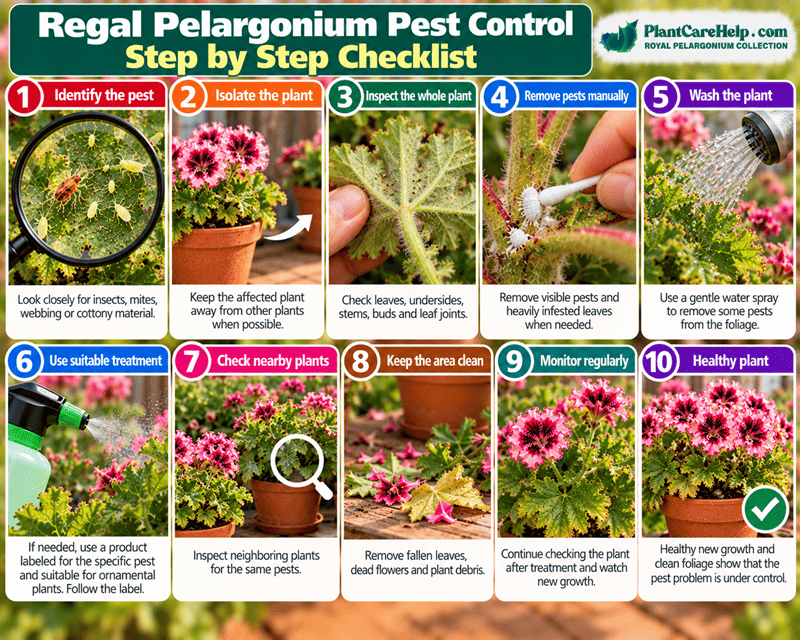
Regal Pelargonium pest control checklist
1. Identify the pest
Look for insects, mites, webbing, honeydew or cottony material rather than diagnosing from leaf damage alone.
2. Inspect the whole plant
Check leaves, undersides, stems, joints, shoot tips, buds and flowers.
3. Separate the plant
Keep an infested plant away from nearby susceptible plants when practical.
4. Check nearby plants
Look for the same pest on plants growing close to the affected Regal Pelargonium.
5. Reduce the pest population
Use appropriate physical removal where practical and remove severely infested tissue when necessary.
6. Choose treatment carefully
If a product is required, use one labeled for the identified pest and appropriate plant use.
7. Follow the label
Use the stated application method, concentration, frequency and safety precautions.
8. Avoid unnecessary treatments
Do not apply several products simply because a leaf looks unhealthy.
9. Reinspect the plant
Continue checking the places where pests were originally found.
10. Watch new growth
Healthy new leaves and shoot tips help show whether the plant is stabilizing.
Frequently asked questions
What are the most common pests on Regal Pelargoniums?
Important pests to check for include aphids, whiteflies, spider mites and mealybugs. Each tends to leave different clues and may concentrate on different parts of the plant.
How do I know if my Regal Pelargonium has pests?
Inspect the plant directly. Look for live pests, fine webbing, sticky honeydew, white cottony material and feeding damage, especially on leaf undersides and tender growth.
What are the tiny insects on my Regal Pelargonium buds?
Aphids commonly gather around tender shoots and buds, but identify the insects before treating because other pests may also occur on the plant.
Why do tiny white insects fly from my Regal Pelargonium?
Whiteflies are one possibility, especially when small pale insects are present on leaf undersides and adults move when foliage is disturbed. Inspect the underside of affected leaves to confirm.
What causes fine webbing on Regal Pelargonium leaves?
Fine webbing together with very small mites and stippled foliage can indicate spider mites. Inspect leaf undersides closely.
What is the white cottony material on my Regal Pelargonium?
White waxy or cottony clusters around stems, leaf joints and protected areas can indicate mealybugs. Look closely for the insects within the material.
Should I isolate a Regal Pelargonium with pests?
Separating an infested plant from nearby plants is useful when practical because it simplifies monitoring and can reduce opportunities for pests to move to neighboring plants.
Can I wash pests off a Regal Pelargonium?
Physical washing can help reduce some pests on suitable foliage, but it may not eliminate an entire infestation. Avoid damaging delicate flowers and continue monitoring afterward.
Should I use insecticide immediately?
Not necessarily. First identify the pest and assess the infestation. If a pest-control product is required, choose one labeled for the target pest and appropriate ornamental plant use, then follow its instructions exactly.
How do I know when the pest problem is under control?
Look for a sustained reduction or absence of live pests, no continuing fresh damage and healthy new growth. Old damaged leaves may remain marked even after control has been successful.
The most important rule
Identify the pest before choosing the treatment. Aphids, whiteflies, spider mites and mealybugs can all weaken Regal Pelargoniums, but leaf symptoms alone are not enough for a reliable diagnosis. Inspect the plant closely, use the least disruptive effective control, and continue monitoring new growth.
Regal Pelargonium varieties
Explore the PlantCareHelp Regal Pelargonium catalog for photographs and individual variety pages.