Spider Mites on Regal Pelargoniums: Signs and Control
Spider mites are tiny plant-feeding pests that can be difficult to notice until Regal Pelargonium foliage begins to show fine pale stippling, speckling or general decline. They often occupy leaf undersides, and fine webbing may appear when an infestation becomes established. Careful inspection is essential because several non-pest problems can produce superficially similar foliage symptoms.
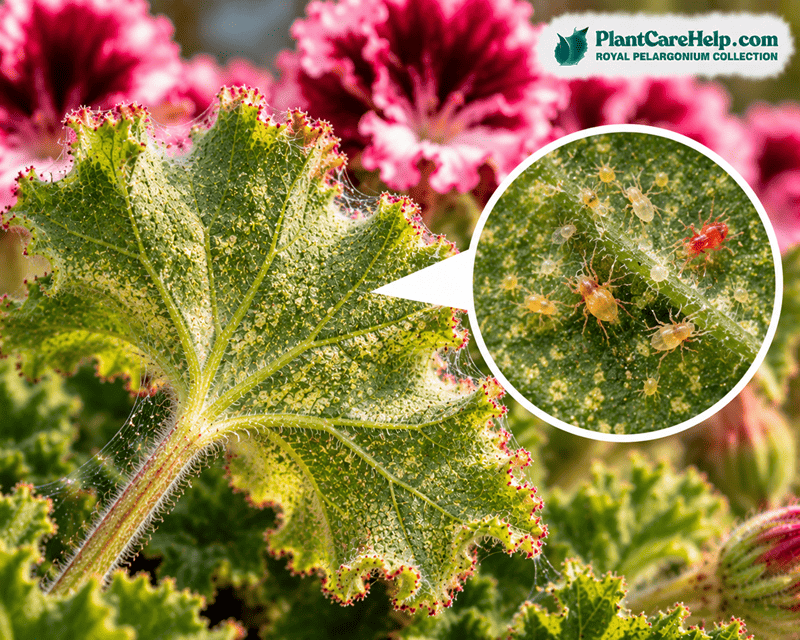
What are spider mites?
Spider mites are tiny plant-feeding pests related to spiders rather than insects. Their small size means that an infestation may be overlooked during a casual inspection.
They feed on leaf tissue and can gradually reduce the healthy appearance of Regal Pelargonium foliage.
Because individual mites can be difficult to see without magnification, growers often first notice changes in the leaves.
How to identify spider mites on Regal Pelargoniums
Look for a combination of pest evidence and foliage symptoms rather than relying on one sign alone. Possible clues include:
- very small mites on leaf undersides;
- fine pale stippling or speckling on foliage;
- leaves gradually losing their healthy appearance;
- fine webbing when an infestation becomes more established;
- progressive decline of affected foliage.
A magnifying lens can make inspection much easier.
Where should you look for spider mites?
🍃 Leaf undersides
Turn leaves over and inspect them closely. Mites can be difficult to see without magnification.
🌿 Protected foliage
Check leaves inside the canopy rather than examining only the most visible outer foliage.
🌱 Damaged leaves
Inspect leaves showing fine pale speckling or a gradual loss of healthy color.
🪴 Nearby plants
When mites are confirmed, inspect neighboring plants for similar pest activity.

What does spider mite damage look like?
One of the most useful foliage clues is fine pale stippling or speckling. Instead of one large damaged patch, a leaf may develop many small pale points.
As feeding continues, affected foliage can lose its normal healthy appearance and may decline further.
Possible signs include:
- fine pale dots or stippling;
- speckled foliage;
- loss of healthy leaf appearance;
- progressive deterioration of affected leaves;
- fine webbing in more established infestations.
Does webbing always mean spider mites?
Fine webbing associated with tiny mites is a strong clue, but webbing should still be evaluated together with the condition of the leaves and direct inspection of the plant.
Do not diagnose mites solely because a strand of web-like material is present somewhere on the plant. Look closely at the affected foliage.
Can spider mites be present without visible webbing?
Yes. The absence of obvious webbing does not rule out spider mites. An earlier or smaller infestation may be easier to recognize from fine stippling and the presence of mites on leaf undersides.
This is why magnified inspection can be useful when symptoms are suspicious.
Why does spider mite damage look speckled?
Spider mite feeding affects many small areas of leaf tissue. The resulting damage can appear as numerous pale points rather than a single uniform patch.
As more tissue is affected, the overall appearance of the leaf may become increasingly unhealthy.
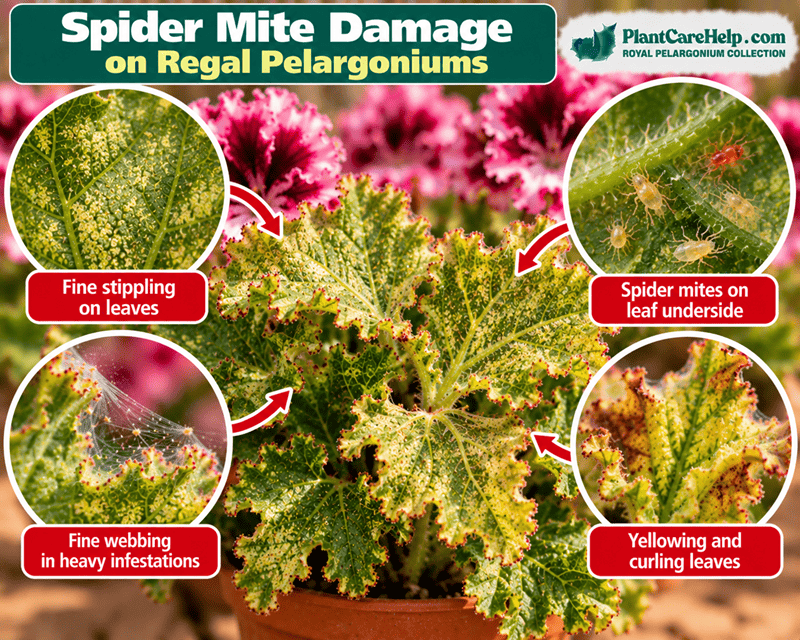
Can spider mites cause yellow leaves?
Spider mite feeding can contribute to foliage losing its healthy green appearance, especially when an infestation becomes substantial. However, yellow leaves have many other possible causes.
If you cannot find mites or other direct evidence, also investigate watering, roots, drainage, nutrition and environmental conditions.
Can spider mites make leaves curl?
Severely affected foliage may become distorted as its condition deteriorates, but curling is not specific to spider mites.
If Regal Pelargonium leaves are curling, inspect them carefully for mites, stippling and webbing before assuming pests are responsible.
How serious are spider mites?
The effect depends on the size and duration of the infestation. A small population discovered early is generally easier to manage than an infestation that has spread across much of the plant.
Persistent feeding can reduce foliage quality and weaken affected growth. For this reason, early identification and continued monitoring are important.
What to do when you find spider mites
Use a systematic response:
- Confirm that spider mites are present.
- Inspect the entire plant, especially leaf undersides.
- Separate the affected plant when practical.
- Check neighboring plants.
- Reduce mites physically where practical.
- Remove severely damaged foliage when appropriate.
- Use a treatment labeled for mites if additional control is necessary.
- Continue inspecting the plant for renewed activity.
Step 1: Confirm the pest
Do not treat every speckled leaf as a spider mite infestation. Look for mites themselves, characteristic fine stippling and, when present, fine webbing.
A magnifying lens is especially useful because the pests are very small.
Step 2: Separate the affected plant
When practical, move the affected Regal Pelargonium away from nearby susceptible plants while the infestation is being managed.
Isolation can simplify monitoring and reduce opportunities for pests to move among closely grouped plants.
Step 3: Inspect the whole plant
Check more than the most obviously damaged leaves. Inspect:
- leaf undersides;
- interior foliage;
- leaves showing fine stippling;
- protected areas within the canopy;
- nearby plants.
This helps determine whether the infestation is localized or widespread.
Step 4: Reduce mites physically
Where practical, washing suitable foliage with water can help physically reduce mites. Direct attention to the leaf surfaces where pests are present.
Use water gently enough to avoid damaging the foliage, stems or flowers. Regal Pelargonium blooms can be delicate, so unnecessary soaking of flowers should be avoided.
Step 5: Remove severely damaged foliage when appropriate
Leaves that are badly damaged and no longer contributing much useful foliage can be removed when appropriate. This may also reduce some of the pest population.
Do not remove large amounts of functional foliage unnecessarily. Use clean tools when cutting plant tissue.
Step 6: Choose the correct treatment if needed
Persistent or substantial spider mite infestations may require an appropriate pest-control product.
Choose a product specifically labeled for mites and suitable for the intended ornamental plant use. Do not assume that every product labeled for insects will control spider mites.
Spider mites are not insects, and not every insect-control product is effective against them. Always confirm that the product label specifically includes mites and follow all application and safety instructions.

Can insecticidal soap control spider mites?
Some insecticidal soap products are labeled for mites on ornamental plants. Whether a particular product is appropriate depends on its label.
If you use one, follow the specified application method, concentration, repeat-treatment directions and plant-safety precautions.
Do not assume household dish detergent is an equivalent substitute for a formulated plant-care product.
Can horticultural oil be used?
Some horticultural oil products are labeled for mite control on ornamental plants. Follow the specific label for permitted uses and restrictions.
Application conditions can matter, so pay attention to any instructions concerning temperature, sunlight, plant condition or sensitive foliage.
Why treatment coverage matters
Spider mites often occupy leaf undersides and protected foliage. If a contact treatment is being used, follow the label carefully regarding where and how it should be applied.
Do not assume that spraying only the visible upper leaf surfaces is sufficient.
Should flowers be sprayed?
Avoid unnecessarily coating Regal Pelargonium flowers. If a commercial product is needed, apply it only according to the label and where required for effective pest control.
Protecting delicate blooms from unnecessary treatment can help avoid avoidable cosmetic damage.
Why repeat inspection is important
A single control action does not guarantee that every mite has been removed. Tiny pests can remain hidden on foliage, and continued inspection helps reveal whether the population is returning.
If a commercial product is used, follow its label for any repeat applications. Do not invent a treatment interval independently of the product instructions.
How often should you treat spider mites?
There is no universal treatment schedule for every product and every infestation. The correct interval depends on the control method and, for commercial products, the label.
Regardless of treatment method, continue inspecting the plant for active mites and fresh foliage damage.
Spider mites or whiteflies?
Spider mites
Very small pests associated with fine stippling or speckling and sometimes delicate webbing.
Whiteflies
Small pale insects found especially on leaf undersides; adults may move or fly when foliage is disturbed.
Spider mites or aphids?
Aphids are generally easier to see and often gather in clusters on tender shoots, buds, young leaves and stems.
Spider mites are much smaller and are more strongly associated with fine stippling on foliage and, in established infestations, fine webbing.
Spider mites or mealybugs?
Mealybugs have a distinctive white cottony or waxy appearance and often gather in protected joints and crevices.
Spider mites are much smaller and may require magnification to see clearly. Their feeding damage typically appears as fine pale stippling rather than cottony pest clusters.
Spider mites or a watering problem?
Foliage decline can also occur when a Regal Pelargonium is overwatered or underwatered. The most useful distinction is direct evidence.
For suspected mites, inspect the foliage for pests, fine stippling and webbing. For a suspected watering problem, check the actual condition of the root zone.
Spider mites or disease?
Not every spotted, pale or deteriorating leaf is caused by mites. If close inspection reveals no mites or webbing, investigate other possible explanations instead of repeatedly applying mite treatments.
Can hot conditions affect spider mite problems?
When a Regal Pelargonium is experiencing hot or drying conditions, its foliage can already be under environmental stress. If mites are also present, the combined effects can make plant decline more noticeable.
Do not respond by changing several care factors blindly. Confirm the pest while also keeping the plant in suitable growing conditions.
Check nearby plants
When spider mites are confirmed, inspect neighboring plants carefully. Pay particular attention to leaf undersides and any foliage showing fine pale speckling.
A magnifying lens can help identify a small infestation before extensive damage develops.
Inspect new plants before adding them to your collection
Before placing a newly acquired plant among established Regal Pelargoniums, inspect its foliage carefully.
Check both leaf surfaces and protected areas within the canopy. Early detection can prevent a small infestation from becoming a collection-wide problem.
Inspect plants before bringing them indoors
Regal Pelargoniums that have spent time outdoors should be checked for pests before they are moved into an indoor growing area.
Look for stippling, inspect leaf undersides with magnification when needed, and check neighboring outdoor plants if mites are found.
Do healthy Regal Pelargoniums get spider mites?
Yes. Good care supports plant health but does not guarantee that spider mites will never appear.
Regular inspection remains useful even when a plant otherwise looks healthy. Finding pests early generally makes the problem easier to manage.
How to tell whether spider mite control is working
Old damaged leaves may remain speckled even after the active infestation has been reduced. Do not use old cosmetic damage as the only measure of success.
Instead, look for:
- fewer or no active mites during close inspection;
- no continuing spread of fine webbing;
- little or no fresh stippling on new foliage;
- healthy developing leaves;
- stabilization of the plant's overall condition.
What if spider mites keep returning?
Reinspect the entire plant and neighboring plants. Mites can be difficult to see, and small populations may remain unnoticed on protected foliage.
If a commercial product was used, check whether it was actually labeled for mites and review its instructions for follow-up applications.
Should damaged leaves be removed?
Dead or severely damaged foliage can be removed when appropriate. However, do not strip the plant of functional leaves simply because old stippling remains visible.
Healthy new foliage and declining pest activity are better indicators of recovery.
Keep the growing area clean
Remove fallen leaves, dead flowers and discarded infested plant material from around the pot. Keeping the growing area orderly makes inspection easier and prevents damaged debris from accumulating.

Regal Pelargonium spider mite control checklist
1. Check the foliage
Look for fine pale stippling or speckling rather than relying on general yellowing alone.
2. Inspect leaf undersides
Turn affected leaves over and look closely for tiny mites.
3. Use magnification
A magnifying lens can make small mites and fine webbing easier to identify.
4. Separate the plant
Keep an affected plant away from nearby susceptible plants when practical.
5. Reduce mites physically
Wash suitable foliage gently where practical without damaging the plant.
6. Remove badly damaged foliage
Severely deteriorated leaves can be removed when appropriate.
7. Use the correct treatment
If additional control is needed, choose a product specifically labeled for mites and suitable ornamental use.
8. Follow the label
Follow application, repeat-treatment, environmental and safety instructions exactly.
9. Check nearby plants
Inspect neighboring plants for mites, stippling or fine webbing.
10. Monitor new foliage
Look for healthy new leaves and an absence of continuing fresh stippling.
Frequently asked questions
What are the first signs of spider mites on Regal Pelargoniums?
Fine pale stippling or speckling on leaves can be an early clue. Inspect leaf undersides with magnification to look for the pests themselves.
Do spider mites always make webs?
No. Fine webbing may appear as an infestation becomes more established, but mites can be present before obvious webbing develops.
Where do spider mites hide?
Leaf undersides and protected foliage are important areas to inspect. Check leaves showing suspicious fine speckling as well as surrounding foliage.
Can I see spider mites without a magnifying glass?
They may sometimes be visible, but their very small size makes magnification useful for reliable inspection.
Can I wash spider mites off a Regal Pelargonium?
Gentle washing can physically reduce mites on suitable foliage. Avoid damaging delicate leaves, stems and flowers, and continue inspecting afterward.
Should I use an insecticide for spider mites?
Do not assume a general insect-control product will work. If treatment is necessary, choose a product whose label specifically includes mites and the intended ornamental use.
Can I use dish soap for spider mites?
Do not assume household dish detergent is equivalent to a formulated insecticidal soap. If using a commercial plant-care product, follow its label.
Why do spider mites keep coming back?
Small populations may remain hidden on foliage, or nearby plants may also be affected. Repeated inspection of the plant and its neighbors is important.
Will damaged leaves turn green again?
Existing stippling and tissue damage may remain visible. Judge recovery mainly by reduced pest activity and healthy new foliage.
Can spider mites spread to other plants?
Nearby plants can become affected, so inspect them when mites are confirmed and separate the infested plant when practical.
The most important rule
Do not wait for heavy webbing before checking for spider mites. Fine pale stippling can appear while the pests are still difficult to notice. Inspect leaf undersides with magnification, confirm that mites are present, reduce the population appropriately, and continue monitoring new foliage for fresh damage.
Regal Pelargonium varieties
Explore the PlantCareHelp Regal Pelargonium catalog for photographs and individual variety pages.