Aphids on Regal Pelargoniums: Identification and Control
Aphids are small sap-feeding insects that can gather on the tender shoots, young leaves, stems and flower buds of Regal Pelargoniums. They are often visible in clusters and may be accompanied by distorted new growth or sticky honeydew. Correct identification is the first step toward controlling them without applying unnecessary treatments.

What are aphids?
Aphids are small insects that feed by drawing sap from plant tissue. They are particularly noticeable when they gather in groups on soft, actively developing parts of a plant.
On Regal Pelargoniums, the first places to inspect are young shoots, buds, new leaves and tender stems.
Aphids can vary in appearance, so identification should be based on the insects themselves, their location on the plant and the accompanying symptoms rather than on color alone.
How to identify aphids on Regal Pelargoniums
Look closely at actively growing parts of the plant. Possible signs include:
- clusters of small insects on young shoots;
- aphids around flower buds and developing flowers;
- insects on young leaves and tender stems;
- distorted or weakened new growth;
- sticky honeydew on foliage or nearby surfaces.
Aphids may be easier to see with a magnifying lens when the infestation is still small.
Where do aphids hide?
A quick glance at the plant can miss an early infestation. Inspect several areas carefully:
🌱 Shoot tips
Tender new growth is one of the most important places to check for aphid clusters.
🌸 Flower buds
Look around developing buds and the stems supporting them.
🍃 Young leaves
Inspect both the upper and lower surfaces of newly developing foliage.
🌿 Tender stems
Small insects can gather along soft stem tissue near actively growing areas.

What does aphid damage look like?
Aphids feed on living plant tissue, and substantial feeding can interfere with the appearance and development of tender growth.
Possible symptoms include:
- distorted young leaves;
- misshapen tender shoots;
- weakened new growth;
- affected flower buds;
- sticky residue on leaves;
- general decline of heavily infested growing tips.
These symptoms are not unique to aphids. Whenever possible, confirm the presence of the insects before deciding that aphids are responsible.
Why are the newest leaves affected first?
Aphids frequently concentrate on soft, developing plant tissue. As a result, the newest growth may show damage while older foliage appears less affected.
This pattern makes the growing tips especially important during routine inspection.
Can aphids damage flower buds?
Yes. Aphids may gather around developing buds and flower stems. When substantial numbers are feeding there, affected buds and surrounding tender tissue can become weakened or distorted.
However, buds can fail or drop for many non-pest reasons as well. If buds are affected but no insects are visible, investigate watering and environmental conditions before assuming aphids are the cause.
What is the sticky substance around aphids?
Aphids excrete a sugary liquid commonly called honeydew. It can leave leaves, stems and nearby surfaces feeling sticky.
Sticky residue can therefore be a useful clue when searching for sap-feeding insects. However, aphids are not the only pests that can produce honeydew, so inspect the plant itself before identifying the pest.
Do aphids cause curled leaves?
Aphid feeding on tender developing foliage can be associated with distorted or curled new growth. But leaf curling also has several non-pest causes.
If curled leaves are present, inspect the affected shoots carefully for insects rather than treating the symptom alone.

How serious are aphids?
The impact depends on the size and duration of the infestation. A small population detected early is different from a heavy infestation covering multiple growing tips and buds.
Large populations can reduce the quality of new growth and make flowers and foliage less attractive. Early detection makes control easier and reduces the amount of damaged tissue.
What to do when you find aphids
Use a systematic approach rather than immediately applying several different products.
- Confirm that the insects are aphids.
- Inspect the entire plant to determine how widespread they are.
- Separate the affected plant from nearby plants when practical.
- Check neighboring plants for aphids.
- Physically remove visible aphids where practical.
- Remove severely infested plant material when appropriate.
- Use additional pest treatment only if needed.
- Continue monitoring after control measures.
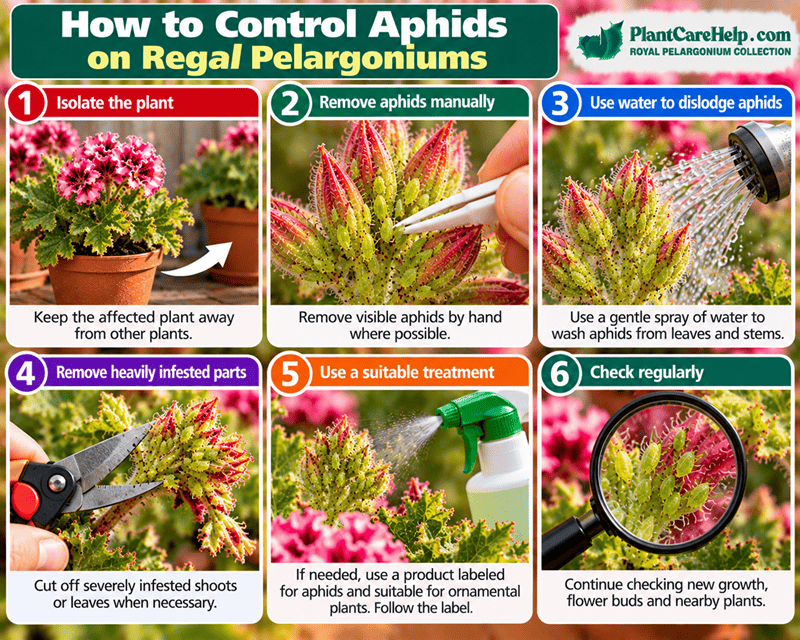
Step 1: Isolate the affected plant
If practical, move an infested Regal Pelargonium away from nearby susceptible plants while you manage the problem.
Isolation makes repeated inspection easier and can reduce opportunities for aphids to reach neighboring plants.
Do not forget to inspect the plants that were previously growing beside it.
Step 2: Remove aphids manually
A small number of aphids can often be removed physically. Depending on where the insects are located, they can be gently dislodged or removed without treating the entire plant.
Pay particular attention to clusters around shoot tips and buds. Avoid crushing or damaging healthy tender growth while removing them.
Step 3: Use water where appropriate
A gentle stream of water can dislodge some aphids from sturdy foliage and stems. Use enough force to remove insects without damaging the plant.
Regal Pelargonium flowers can be delicate, so avoid unnecessarily soaking or damaging blooms while washing foliage.
Afterward, inspect the plant again because hidden aphids may remain.
Step 4: Remove heavily infested tissue when necessary
A shoot or leaf that is severely damaged and densely covered with aphids may be removed when appropriate. This can reduce the pest population quickly.
Do not remove large amounts of healthy foliage unnecessarily. Use clean cutting tools when pruning plant tissue.
Step 5: Decide whether additional treatment is needed
Physical removal may be sufficient for a small infestation, but larger or persistent populations may require an appropriate pest-control product.
Choose a product that is labeled for aphids and suitable for the intended ornamental plant use. Follow the product label for:
- application method;
- concentration;
- repeat-treatment instructions;
- environmental restrictions;
- plant-safety information;
- personal safety precautions.
Do not improvise concentrations or combine pest-control products unless their labels specifically permit it. Always use the label as the primary instruction for a commercial treatment.
Can insecticidal soap be used for aphids?
Some insecticidal soap products are labeled for aphid control on ornamental plants. If you choose one, verify that the product label allows the intended use and follow all directions exactly.
Do not substitute an improvised household soap mixture for a formulated plant-care product simply because both contain the word “soap.”
Can horticultural oil be used?
Some horticultural oil products are labeled for aphid management. Suitability depends on the specific product, plant condition and application conditions.
Follow the label carefully, including any restrictions concerning temperature, sunlight, sensitive plants or flowers.
Should you spray Regal Pelargonium flowers?
Avoid unnecessarily applying treatments to flowers unless the product label and pest location make that application appropriate.
When aphids are concentrated around buds or flower stems, follow the specific product directions rather than assuming that all blooms should be sprayed.
Why repeat inspection matters
Removing visible aphids once does not guarantee that the infestation has ended. Some insects may remain hidden on young leaves, stems or buds.
Continue checking:
- new shoot tips;
- developing leaves;
- leaf undersides;
- flower buds;
- flower stems;
- areas where clusters were previously found.
How often should you treat aphids?
There is no universal treatment interval for every control method or product. If you use a commercial treatment, follow its label for repeat applications.
For physical control, continue inspecting the plant and remove aphids that reappear.
Check nearby plants
Aphids should not be treated as a problem belonging only to the visibly infested pot. Examine nearby plants for the same insects, especially on tender growth.
Early detection on neighboring plants can prevent a small problem from becoming a larger collection-wide infestation.
Can ants indicate aphids?
Ant activity around sticky honeydew can sometimes draw attention to a sap-feeding pest problem. However, ants alone do not prove that aphids are present.
Inspect the Regal Pelargonium directly and look for the insects.
Aphids or whiteflies?
Both are sap-feeding insects and both can be associated with honeydew, but their appearance and behavior differ.
Aphids
Often gather in visible clusters on tender shoots, buds and young leaves.
Whiteflies
Are especially important to look for on leaf undersides, and adults may fly when foliage is disturbed.
Aphids or spider mites?
Spider mites are much smaller and can produce fine stippling on foliage. Fine webbing may become visible when mite infestations are established.
Aphids are generally easier to see as individual insects and commonly cluster around soft new growth.
Aphids or mealybugs?
Mealybugs have a distinctive white, waxy or cottony appearance and often occupy sheltered leaf and stem joints. Aphids do not have the same cottony covering and are frequently concentrated on tender exposed growth.
Can aphids cause yellow leaves?
A substantial infestation can weaken affected growth, but yellow foliage has many possible causes. If aphids are absent, investigate watering, drainage, roots, nutrition and environmental conditions.
Can aphids stop a Regal Pelargonium from growing?
A heavy infestation on developing shoots can interfere with healthy new growth. However, slow or stalled growth can also result from root problems, unsuitable conditions or seasonal changes.
Confirm aphid activity before attributing the entire growth problem to pests.
How to reduce future aphid problems
No routine can guarantee that aphids will never appear, but regular inspection can help detect them before populations become large.
- Inspect shoot tips frequently during active growth.
- Check flower buds and young leaves.
- Inspect newly acquired plants before placing them with a collection.
- Check plants before bringing them indoors.
- Examine neighboring plants when aphids are found.
- Remove dead and heavily damaged plant material when appropriate.
- Keep plants in suitable growing conditions.
- Continue monitoring after an infestation appears to be controlled.
Inspect plants before bringing them indoors
A Regal Pelargonium that has been outdoors should be examined before it is placed among indoor plants.
Look closely at tender shoots, buds, young foliage and stems. An infestation that is easy to overlook outdoors can become more noticeable after the plant is moved inside.
Inspect new plants before adding them to your collection
Before placing a newly acquired Regal Pelargonium beside established plants, inspect the growing tips and buds for small insects.
Finding aphids early makes it easier to isolate and manage the affected plant before pests spread to neighboring specimens.
Do healthy Regal Pelargoniums get aphids?
Yes. Good care supports healthy growth, but it does not make a Regal Pelargonium immune to aphids.
Aphids can reach healthy plants from other vegetation or arrive on newly introduced plant material. Regular inspection remains important even when plants otherwise appear vigorous.
How to tell whether control is working
Do not expect distorted old leaves to become perfectly shaped again. Existing damage can remain visible after aphids have been controlled.
Instead, look for:
- fewer or no live aphids;
- no new clusters forming on shoot tips;
- reduced fresh damage;
- healthy developing leaves;
- healthy new shoot growth;
- normal development of new buds.
What if aphids keep returning?
If aphids repeatedly reappear, inspect the entire plant and nearby plants again. Hidden insects or untreated neighboring plants may be contributing to the recurring problem.
Review whether the chosen control method was appropriate for aphids and whether any commercial product was used according to its repeat-treatment instructions.
Should damaged leaves be removed?
Dead, severely distorted or heavily infested tissue can be removed when appropriate. However, do not strip the plant of useful healthy foliage merely because older leaves show cosmetic damage.
The condition of new growth is a better indicator of recovery.
Keep the growing area clean
Remove fallen leaves, dead flowers and discarded infested material from around the pot. This keeps the growing area easier to inspect and prevents damaged plant debris from accumulating.
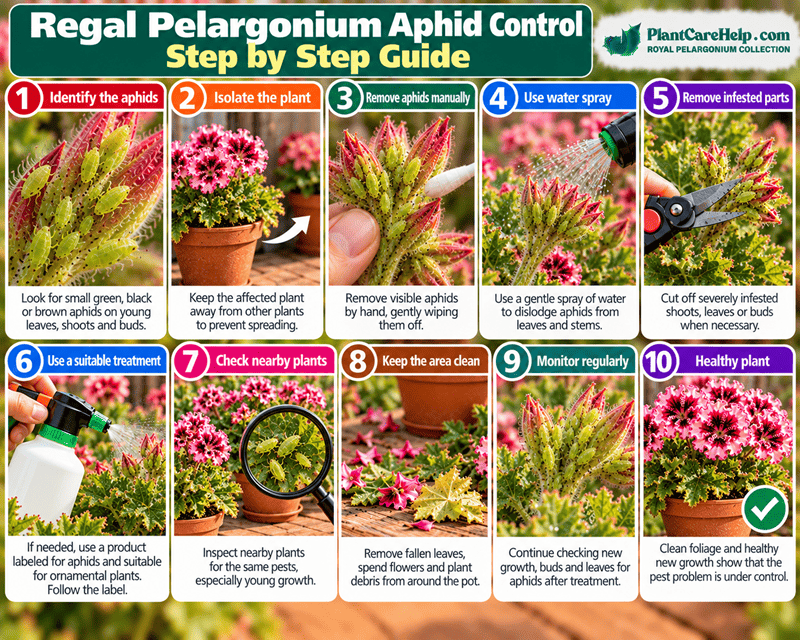
Regal Pelargonium aphid control checklist
1. Confirm the insects
Look for small aphids clustered on tender shoots, young leaves, buds or stems.
2. Check for honeydew
Sticky residue can support the diagnosis, but confirm the pest itself whenever possible.
3. Inspect the whole plant
Check shoot tips, leaf undersides, buds, flower stems and other tender growth.
4. Separate the plant
Keep the affected plant away from nearby susceptible plants when practical.
5. Remove visible aphids
Use careful physical removal when the infestation is limited.
6. Remove badly infested tissue
Severely damaged shoots or leaves can be removed when appropriate.
7. Treat only when needed
If additional control is necessary, use a product labeled for aphids and appropriate plant use.
8. Follow the label
Use the specified concentration, application method, frequency and safety precautions.
9. Check neighboring plants
Inspect nearby plants for aphids, especially around their tender growing tips.
10. Monitor new growth
Watch for fresh aphid clusters and check whether new leaves and shoots are developing normally.
Frequently asked questions
Where do aphids usually appear on Regal Pelargoniums?
They commonly gather on tender shoots, young leaves, flower buds and soft stems. These actively developing areas should be inspected first.
What do aphids look like on a Regal Pelargonium?
They are small insects that may appear in clusters on tender growth. Their exact appearance can vary, so use their body shape, clustering behavior, location and associated honeydew or growth distortion together for identification.
Why are my Regal Pelargonium leaves sticky?
Aphids produce sugary honeydew that can make leaves and nearby surfaces sticky. Other sap-feeding pests can also produce honeydew, so inspect the plant to identify the pest.
Can aphids damage Regal Pelargonium flowers?
Aphids can feed around flower buds and stems and may weaken or distort affected tender tissue. Check buds closely when aphids are present.
Can I wash aphids off?
A gentle stream of water can remove some aphids from sturdy foliage and stems. Avoid damaging delicate flowers and inspect the plant again afterward.
Should I spray an aphid infestation immediately?
Not always. Small infestations may be reduced with physical removal. If additional treatment is needed, choose a product labeled for aphids and follow its instructions.
Can I use dish soap on aphids?
Do not assume household dish soap is equivalent to a formulated insecticidal soap. If using an insecticidal soap product, choose one labeled for the intended plant and pest use and follow the label.
Why do aphids keep coming back?
Some insects may have been missed, or nearby plants may also be infested. Repeat inspection of the affected plant and neighboring plants is important.
Will aphid-damaged leaves recover?
Existing distorted or damaged foliage may remain marked. Judge recovery by the absence of fresh infestations and the development of healthy new leaves and shoots.
How can I prevent aphids?
Aphids cannot always be prevented completely. Regular inspection of new growth, buds and newly introduced plants helps detect infestations early and makes control easier.
The most important rule
Do not diagnose aphids from leaf damage alone. Look directly at tender shoots, young leaves, buds and stems for the insects. Once confirmed, reduce the population with appropriate physical control, use a labeled treatment only when necessary, and keep checking new growth for fresh aphids.
Regal Pelargonium varieties
Explore the PlantCareHelp Regal Pelargonium catalog for photographs and individual variety pages.